Found a Dead Animal in Your House? What to Do Before Calling Someone
Finding a dead animal inside the house is not something most people have a plan for. Whether you have seen it or simply followed a smell to one corner of a room, there is a short window before you call anyone where a few sensible actions make a real difference.
None of this is about doing the removal yourself. It is about not making the problem bigger and giving whoever attends enough information to go straight to the right place.
Stop the Air Moving Through the House
Turn off ducted air conditioning and any whole-house fan. A running system pushes odour into rooms that were unaffected and makes locating the source much harder, because the smell ends up everywhere at once.
Close the doors of rooms you are not using, and open windows only where you need to be. The aim is to contain the odour, not distribute it evenly.
Keep Pets and Children Out of the Area
A carcass sheds its parasite load as it cools. Fleas, ticks and mites leave the body looking for a new host, which is why people sometimes notice bites in the days afterwards. Dogs will try to reach a carcass and cats will investigate a cavity given the chance.
Close the room off if you can. If the animal is in a roof or wall cavity, keep pets out of the room below or beside it.
Write Down What You Have Noticed
This is the part that genuinely speeds things up, and most people arrive at the phone call without it. Before you ring anyone, note the following:
- When the smell started, as close to a date as you can manage.
- Which room you noticed it in first, and where it is strongest now.
- Whether it is worse high or low in the room, and whether afternoons are worse than mornings.
- What you heard beforehand. Scratching in the ceiling that stopped a few days before the smell began is a very strong clue, and so is roughly how heavy it sounded.
- Where the flies are gathering. Blowflies at a particular window, downlight or power point point straight at the source.
- Any ceiling or wall staining, including whether it is still spreading.
- Whether bait has been laid recently, by you, a neighbour or a pest contractor.
Species, location and rough timeframe are usually enough for an experienced technician to tell you over the phone what is likely involved and what the job will require.
Photograph Anything Visible
If there is a stain on the ceiling, photograph it with something alongside for scale and note the date. If the smell has been going for a while, take another photo a day later. A stain that is still growing tells you the carcass is still releasing fluid, which affects how much insulation and plaster will need attention.
Photographs also matter if you are renting, managing the property for someone else, or intending to make an insurance claim. It is far easier to document the problem before anyone opens up a ceiling than afterwards.
What Not to Do
- Do not spray deodoriser or light scented candles. Masking the smell removes the main tool available for locating the source, and technicians work the odour gradient to find it.
- Do not cut an access hole on a guess. Unnecessary holes in plasterboard are expensive to repair and are usually in the wrong place.
- Do not climb into the roof cavity. Plasterboard will not hold your weight, wiring is often unclipped and buried in insulation, and summer cavity temperatures are genuinely dangerous.
- Do not paint over a ceiling stain. It will come back through, and you lose the ability to see whether it is still spreading.
- Do not pull out insulation yourself. Disturbing contaminated batts releases particulate into the room below.
- Do not wait for it to pass. In Brisbane's heat the contaminated area expands well before the smell begins to fade.
If the Animal Is Accessible and Clearly Visible
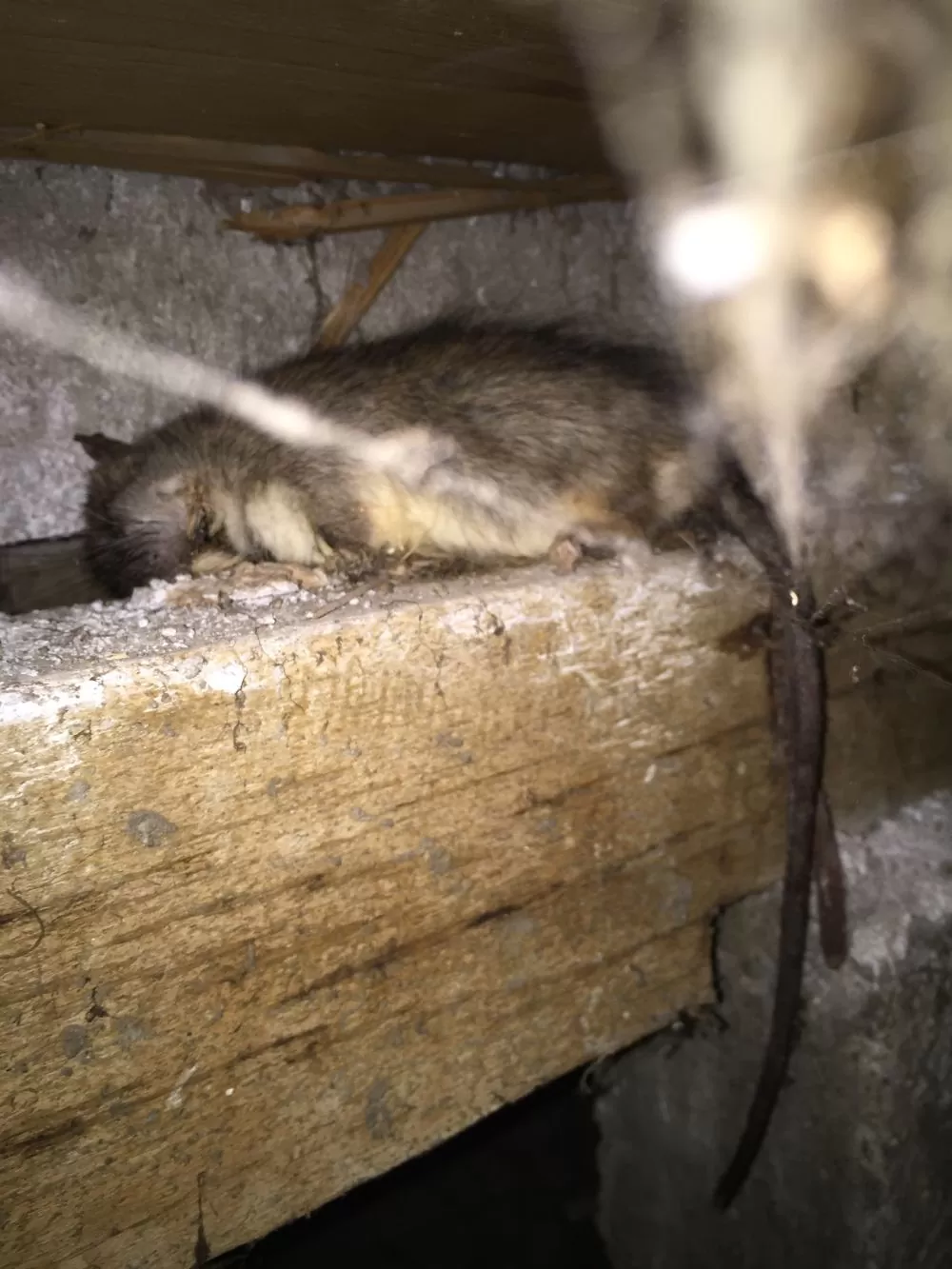
A small, freshly deceased animal sitting in the open, in a garage or laundry, with no sign of baiting, is something many people reasonably handle themselves. Disposable gloves, doubled heavy-duty bags, a thorough wash of the surface afterwards with an enzyme-based product rather than bleach, and proper handwashing regardless of what you wore.
If it is inside a ceiling, wall or subfloor, if it is a larger animal, or if there is any chance it took bait, it is worth leaving alone. The difficulty in these jobs is rarely the animal itself. It is locating it precisely and dealing with the contaminated material around it.
What to Ask When You Call
- Does the quote include sanitising and odour treatment, or is removal priced on its own?
- What happens to contaminated insulation, and is its removal included?
- Will the technician identify the entry point so it can be closed afterwards?
- Is the price confirmed on site before work starts?
Removal without decontamination is the most common reason a smell returns a fortnight later, so it is worth confirming what is actually included rather than comparing headline prices.
If you have found something, or you are following a smell you cannot place, get in touch with what you have noted down. In most cases that is enough for us to tell you what you are dealing with before anyone comes out.